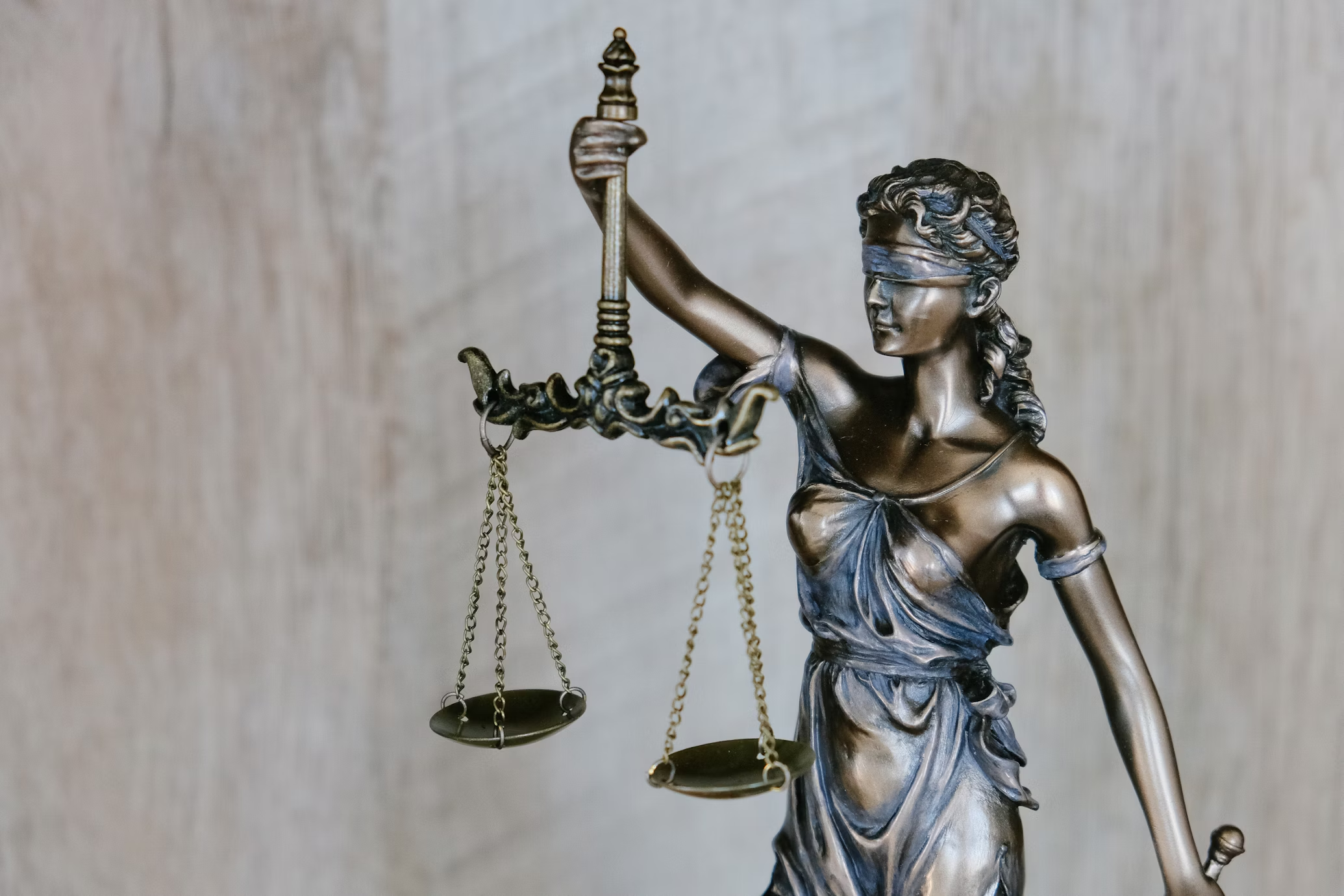
Supreme Court Decisions: Key Insights for Legal Professionals || 03 February 2026
Supreme Court Decisions: Key Insights for Legal Professionals || 03 February 2026
Supreme Court Decisions: Key Insights for Legal Professionals || 03 February 2026
Supreme Court Decisions: Key Insights for Legal Professionals || 03 February 2026
Supreme Court Unpacks Crucial Legal Frontiers: Essential Insights for Professionals
Stay ahead with our concise overview of recent Supreme Court pronouncements shaping legal landscapes in dispute resolution, governance, and commercial law. These rulings offer critical insights for legal practitioners, policymakers, and business leaders navigating complex regulatory environments.
Featured Case: SC Mandates Tribunal for Pennaiyar River Dispute: A Landmark Decision on Inter-State Water Governance
In a pivotal ruling, the Supreme Court has directed the Central Government to constitute an Inter-State River Water Disputes Tribunal for the Pennaiyar River dispute between Tamil Nadu and Karnataka. This decision underscores the judiciary's firm stance on resolving inter-state resource conflicts, emphasizing the mandatory nature of Section 4 of the Inter-State River Water Disputes Act, 1956, when negotiation efforts fail. Professionals in governance, environmental law, and infrastructure development should note this decisive judicial intervention, which reiterates constitutional principles governing resource sharing and sets a precedent for managing federal disputes impacting state economies and populations.
Read the Full Article: Here
The State of Tamil Nadu VS The State of Karnataka & Anr., decided on 02-02-2026
Other Supreme Court Decisions You Might Find Interesting:
Arbitration Mandate Extensions: SC Clarifies Court's Powers Even Post-Award Expiry
A significant judgment for arbitration practitioners, the Supreme Court has clarified that an application to extend an arbitrator's mandate under Section 29A(5) of the Arbitration and Conciliation Act, 1996, is maintainable even if an award has been rendered after the mandate's expiry. This ruling safeguards the efficiency and integrity of arbitration proceedings by empowering courts to rectify procedural delays, ensuring that awards are not set aside solely on technicalities, provided sufficient cause exists. It reinforces the legislative intent to facilitate the ultimate passing of an award rather than prematurely terminating proceedings.
Read the Full Article: Here
C. VELUSAMY VS K INDHERA, decided on 03-02-2026
High Court's Disqualification Power Limited: SC Reaffirms President's Role in Election Corrupt Practices
This significant ruling delineates the jurisdictional boundaries of High Courts in election petitions. The Supreme Court affirmed that while a High Court can declare an election void for corrupt practices, the power to impose a disqualification period rests exclusively with the President of India, acting on the Election Commission's opinion, as mandated by Section 8A of the Representation of the People Act, 1951. This decision upholds the principle of separation of powers and ensures consistency and due process in the application of election law penalties for corrupt practices.
Read the Full Article: Here
K.M. SHAJI VS M. V. NIKESH KUMAR & ORS., decided on 29-01-2026
SC Restores NI Act Complaint Dismissed for Default, Emphasizing Justice Over Technicalities
In a move aimed at ensuring substantive justice, the Supreme Court restored a complaint case under Section 138 of the Negotiable Instruments Act, 1881, which had been dismissed for default by lower courts. This decision underscores the judiciary's commitment to allowing cases to be heard on their merits, preventing procedural oversights from derailing legitimate claims. It serves as an important reminder for legal professionals to meticulously track case statuses, while also offering recourse against dismissals based purely on technical default in commercial disputes involving dishonored cheques.
Read the Full Article: Here
YATENDRA SINGH VS STATE OF U.P. & ANOTHER, decided on 30-01-2026
Stay Updated with Legal Insights
Subscribe to our newsletter for regular updates on legal developments and regulatory changes that impact your business.